Workplace Flexibility Infographic
Flexibility is no longer just a perk - it’s a necessity for attracting and retaining top talent. Our latest infographic highlights key trends shaping time management across Europe, revealing how businesses are adapting to employee expectations with smarter, more effective strategies.

Related articles
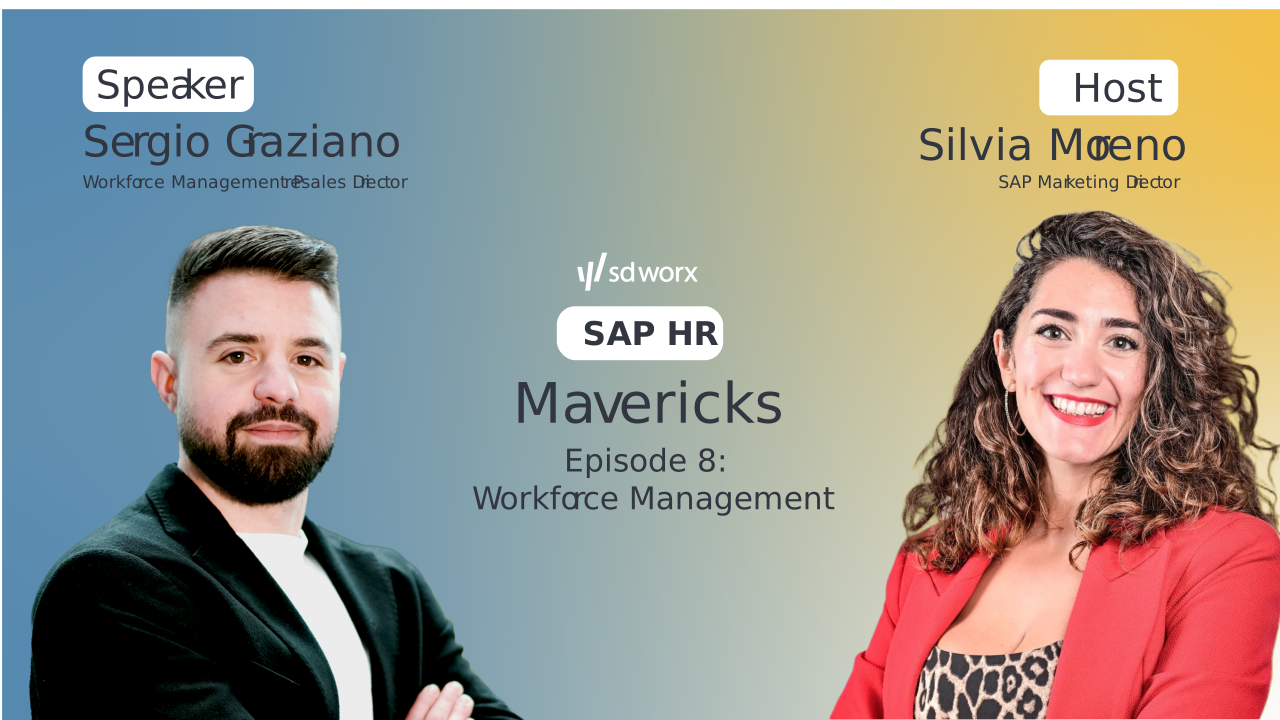
SAP HR Mavericks Podcast | Episode 8: Workforce Management
In this episode of the SAP HR Mavericks podcast, our host Silvia Moreno Rodriguez, SAP Marketing Director, is joined by Sergio Graziano, Pre-Sales Lead for Workforce Management at SD Worx, to talk about how workforce management has moved from a back-office task to a boardroom priority.
In this episode, we cover:
- Why workforce management is no longer just time and attendance: Clocking in and out used to be the whole story. Now scheduling, payroll integration and employee experience all sit under one system, and Business Leaders are starting to see the impact this has on payslip accuracy and staff retention.
- How skills are replacing job titles in scheduling: Companies are moving away from filling fixed roles and toward matching tasks to the people best suited for them. This shift also takes employee preferences and availability into account, which is changing how schedules get built.
- Where AI is actually making a difference today: AI is automating scheduling decisions and starting to let non-technical users write policies and rules in plain language. On the compliance and configuration side, AI still has a way to go and remains an area for the future.
- What happens when humans and AI agents share a schedule: Sergio shares his view on how planning will eventually include both people and AI agents working side by side, and why organisations need to start thinking now about how that division of labour will work.
- Why compliance is the biggest hidden cost: With regulations changing by country and by year, especially across Europe, non-compliance is not just a fine. It is wasted time, wasted budget and, in some cases, a legal risk.
Tune in to hear Sergio's take on what HR Leaders should be focusing on right now, and get a glimpse of what workforce management could look like by 2030.

Re-Humanising Organisations: The Core of Industry 4.0 Resilience
Henrik von Scheel is recognised as one of the most influential futurists of the century and is credited with originating Industry 4.0. His work has impacted 24 nations and 23% of Fortune 500 companies. This article is an excerpt from his recent webinar, “Resilient Workforce Strategies in the Era of Industry 4.0”.
* * *
As someone who helped ignite the Fourth Industrial Revolution, I'm often asked to explain not just what Industry 4.0 is, but why it matters for the future of work and manufacturing. Today, I want to share with you the human dimension of this transformation—the aspect that many overlook when focusing solely on technology.

The Future of Manufacturing: Where Industry 4.0 Meets Workforce Management
In today's rapidly evolving manufacturing landscape, one thing is clear: companies that fail to embrace digital transformation risk being left behind. As factories become smarter and more connected, the question isn't whether to digitalise—it's how quickly you can adapt your workforce strategy to keep pace with technological change.