1. Home>
  2. Insights>
  3. Payroll & Reward>
SD Worx International - Roundtable in Barcelona

Global payroll, real conversations: what leaders openly shared

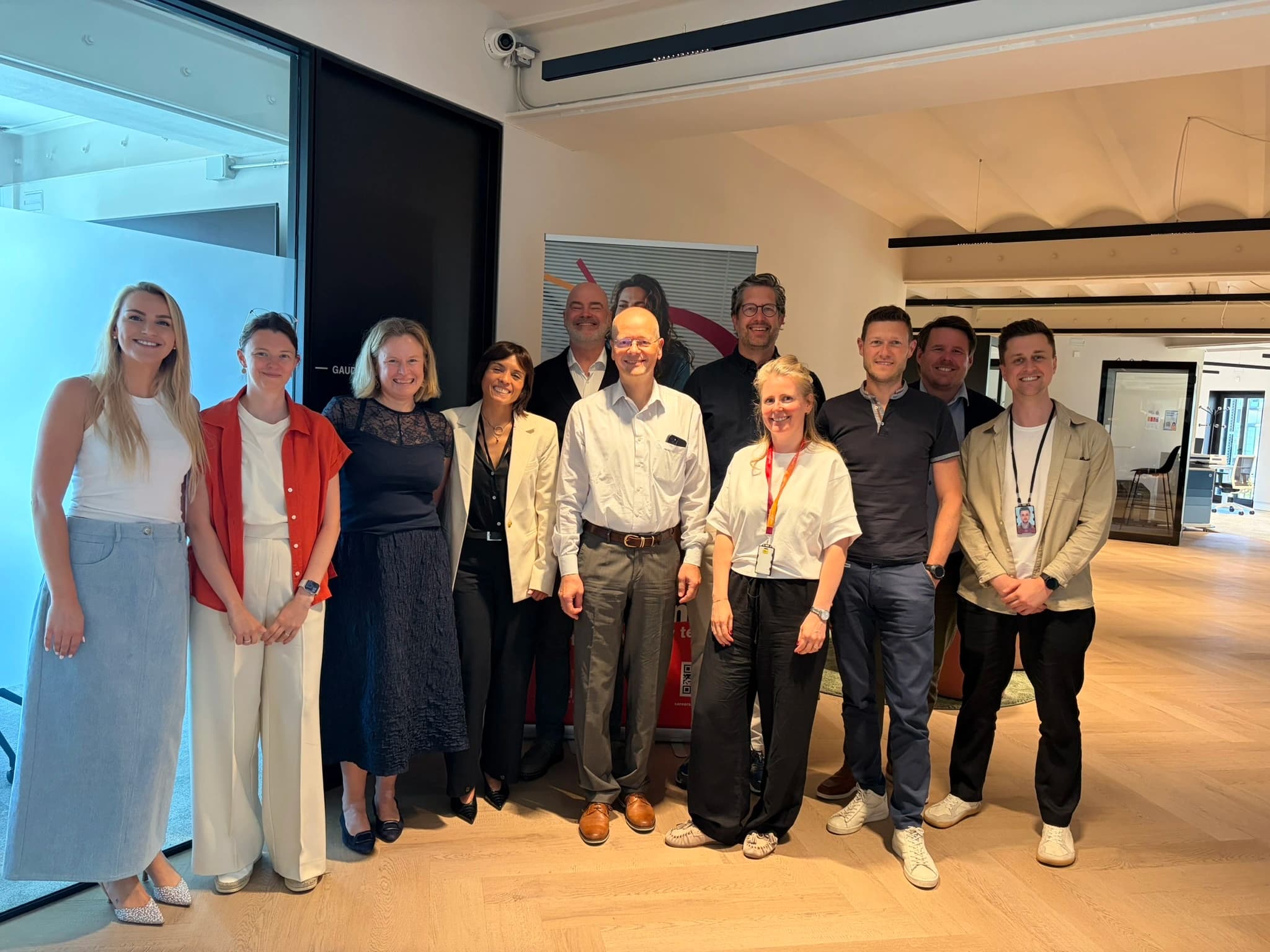
On the eve of the Global Payroll Awards 2026 in Barcelona, we brought together a select group of international payroll leaders for a closed roundtable.  

No presentations. No sales pitches. Just a single objective: peer-to-peer exchange on what’s really happening in global payroll.  

Across five key themes, the same tensions kept surfacing:  

  • between control and operational reality 
  • between ambition and structural readiness 
  • between the promise of technology and the complexity of organisations it’s meant to serve 

Here’s what stood out. 

    1. Global standardisation versus local excellence  

     Can you really have both?  

    Few tensions in global payroll are as persistent as the one between central standardisation and local operational reality. Central teams push for standardisation: consistency, visibility, control. Local teams push back, not out of resistance but because reality on the ground rarely fits a global template.  

    And they’re not wrong.  

    In production environments especially, complexity spikes: shift patterns, time tracking, variable pay, local regulation. This is where “one-size-fits-all” models tend to break down and where the cost of getting it wrong is highest. 

    So the conversation quickly moved beyond theory. 

      The real question isn’t global or local

      It’s: where do you standardise, where do you flex — and are you honest about that trade-off from the start? 

      Because organisations that underestimate operational complexity usually discover it at the worst possible moment: mid‑implementation, when changing direction is expensive.  

        HR & Payroll Pulse 2026

          Takeaway: Don’t choose between global and local. Design for both from the start.  

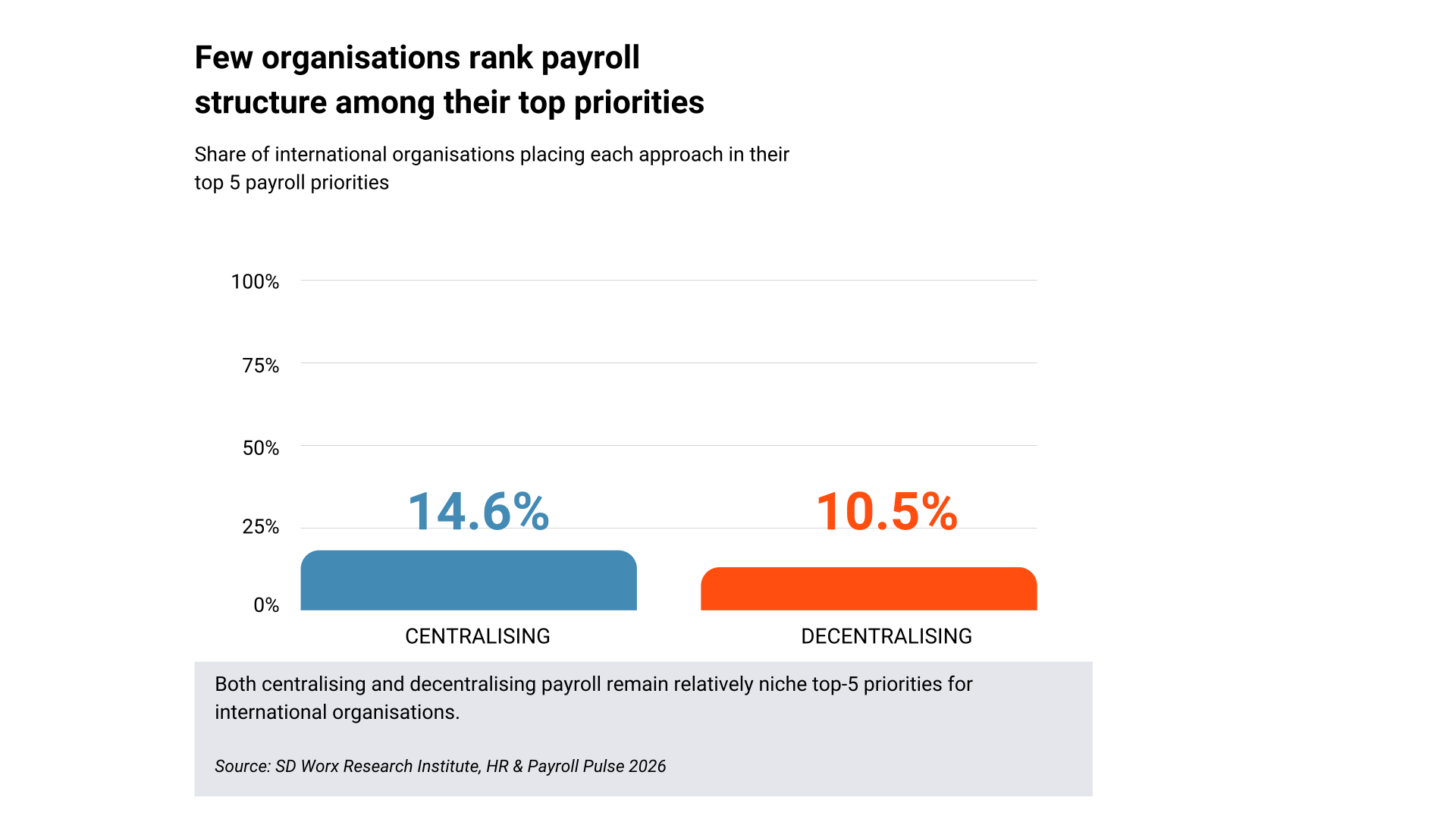
          What research learns: Recent numbers of the SD Worx Research Institute show that 14.6% of international organisations place “Centralisation of payroll across multiple countries or business units” in the top 5 of payroll priorities whereas 10.5% consider “Decentralisation of payroll to regional or local teams” to be a top 5 priority. 

            2. Where global payroll actually breaks 

            Systems, processes... Or something else?  

            Payroll is one of the few processes every employee touches every month. Which makes it more than operational: it’s a layer of trust. 

            And yet, beneath that surface, inefficiencies often accumulate quietly: manual steps, fragmented systems, inconsistent processes, compliance risks. 

            The instinct is to look at systems. The discussion in the room pointed elsewhere.

              HR & Payroll Pulse 2026

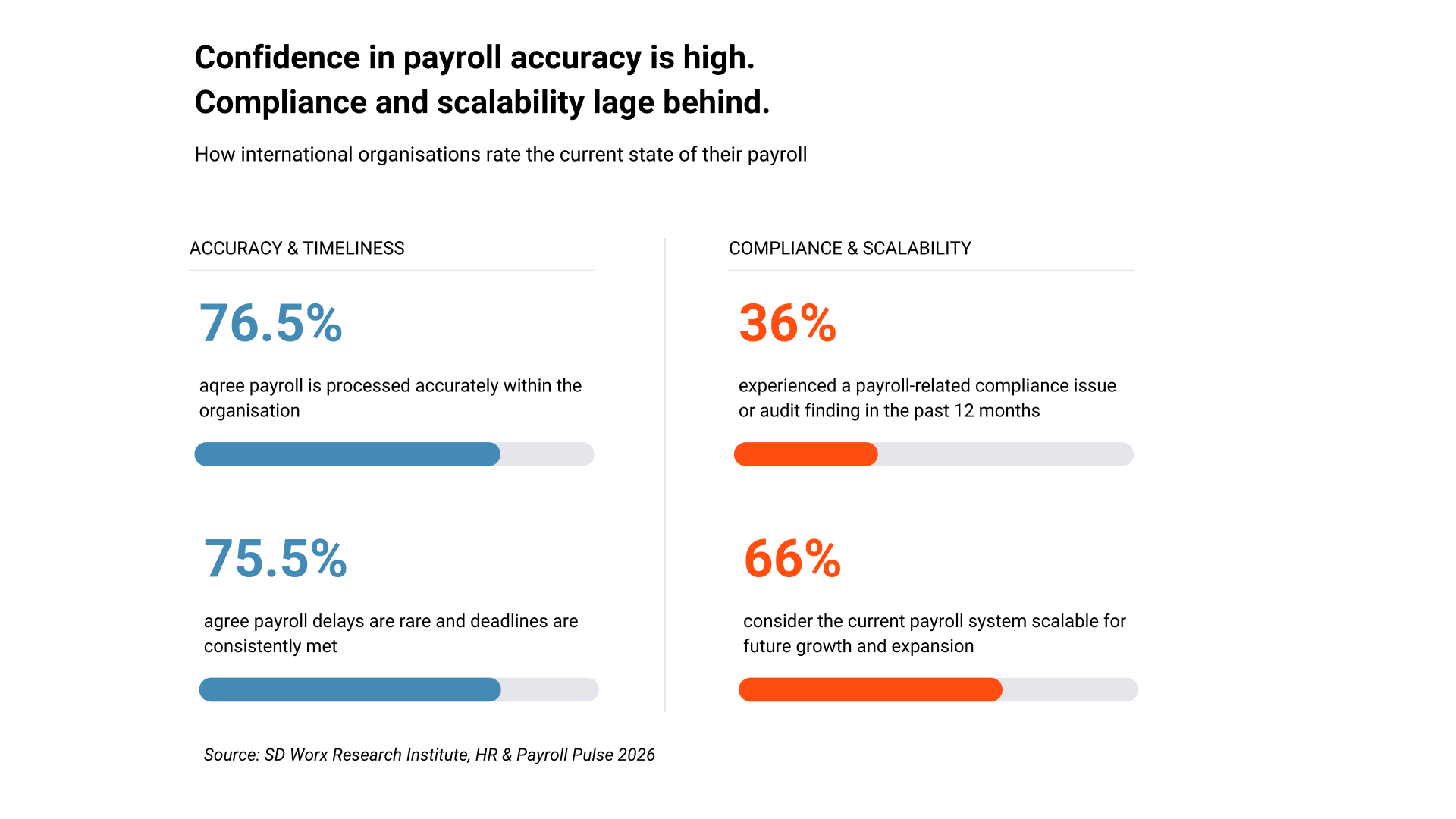
                What research learns: 76% of international organisations agree with the statement that payroll is processed accurately within the organisation. Almost 76% also agree that payroll delays are rare, and the organisation consistently meets it payroll deadlines. However, almost 36% of international organisations experienced payroll-related compliance issues or audit findings in the past 12 months. And only 66% considers the current payroll system scalable to meet future growth and expansion.  

                  Manual work remains the biggest source of errors. 

                  Customers’ reaction was surprisingly unanimous: despite increasing automation, manual work remains the biggest source of errors. Not because automation has failed, but because critical handoffs still depend on human intervention. 

                  A missed step under pressure. 
                  A correction outside the system. 
                  A small input error that cascades. 

                  The pattern is familiar. And it leads to a harder truth: a well-designed process, consistently followed, will outperform a sophisticated system used inconstantly.  

                  This also reframes outsourcing. It may solve ownership questions,  but it doesn’t fix upstream process gaps. If the data going in isn’t reliable, the output won’t be either. 

                    Takeaway: Most payroll failures are not system failures. They’re process gaps. 

                      3. Who really owns payroll?

                      HR, Finance, Shared Services or no one?  

                      This was the theme that triggered the fastest recognition around the table. Because everyone has lived it. Payroll sits between functions. Claimed by many, fully owned by none. 

                      Formally, it usually sits within HR. In practice, leading teams increasingly borrow from Finance: analytics, reporting discipline, business cases, risk framing. 

                      And that’s where the discussion became more interesting. Ownership, it turns out, is not the real issue. Alignment is.  

                        💡 A broader view on payroll's place in the organisation

                        The roundtable reinforced a structural reality that often goes unspoken: 

                        • Reporting lines matter less than shared understanding. Whether payroll sits under HR or Finance, what determines effectiveness is whether all parties understand how their actions create downstream impact for the others. 
                        • HR proximity creates foresight. Advance visibility of upcoming hires, terminations or restructuring allows payroll to prepare  and to share critical numbers with Finance before they become surprises. 
                        • Finance fluency is non-negotiable. Payroll leaders who can speak to budgeting, accruals and reporting accuracy earn a different kind of credibility (and access) at the leadership table. 
                        • Compliance is embedded. Legal and regulatory requirements have become so embedded in payroll operations that treating them as someone else's responsibility is a governance risk in itself. 
                        • Operations needs to be in the room. Payroll policy decisions as timelines, correction windows or cut-off dates; have direct operational consequences. Those consequences are best understood before the policy is set, not after. 

                          Takeway: Payroll doesn’t need a stronger “owner”. It needs stronger cross-functional alignment. In most organisations, payroll has evolved into a critical business function, sitting at the intersection of HR, Time, Finance, Operations, Compliance, and employee trust. No single reporting line solves that. What solves it, is mutual understanding and payroll leaders who can operate fluently at that intersection. 

                            4. AI in payroll: real value versus hype

                            Where has AI actually delivered? And are we ready for what comes next?  

                            AI is everywhere right now, in vendor messaging, roadmaps, conference agendas. But when the room in Barcelona was asked to strip away the buzzwords and speak honestly, a more nuanced picture emerged.  

                              What research learns: Recent numbers of the SD Worx Research Institute show that 49% of international companies are already using AI-powered tools or agent in HR. 48% report seeing outcomes from AI adoption. 49% are also actively investing in AI initiatives. At first glance, strong progress. But the nature of those "outcomes" remains largely undefined. Are organisations improving efficiency in isolated tasks — or genuinely transforming end-to-end processes like payroll, compliance and workforce planning? That distinction matters enormously. 

                                The feedback in the room was clear and refreshingly direct: the gap between vendor promise and proof is still too wide. 

                                HR Leaders are not against AI. They’re impatient with abstraction. They want to see real use cases, at real scale, solving real problems. 

                                SD Worx's response to that challenge is grounded in four concrete areas where AI is already delivering: implementation support, knowledge AI, agentic coding and agentic operations. Not a roadmap. Not a vision deck. Working capabilities, in production, at scale. 

                                The conversation then moved to a bigger question: are organisations ready for what comes next? The concept of systems of intelligence: not systems that store data, but systems that interpret, contextualise and act, resonated strongly with the group. The vision itself was broadly supported. The doubts were practical: how do you get there from here? How do you manage the adoption of the new technology? 

                                  Takeaway: AI in payroll is real, but only where it is grounded in actual use cases and delivered at scale. The leaders in the room were not asking whether AI has a role. They were asking vendors to close the gap between the promise and the proof. And they were right to ask. 

                                    💡 From systems of record to systems of intelligence: what the shift actually means  

                                    For years, payroll technology has been built around systems of record: platforms designed to store, manage and process data in a structured, compliant and auditable way. They answer the question "What has happened?". They are reliable, rules-based and inherently reactive. 

                                    Systems of intelligence build on that foundation, but serve a fundamentally different purpose: 

                                    • They interpret, not just store. A system of intelligence flags the trend, explains the cause, predicts the impact and suggests corrective action. 
                                    • They contextualise in real time. Rather than storing policy documents, they surface the right policy for the right employee situation, at the right moment. Drawing on compliance databases, internal knowledge and live data simultaneously. 
                                    • The interface becomes the experience. Users no longer navigate between applications. They interact with a layer that understands intent and orchestrates the underlying systems on their behalf. The experience becomes conversational, proactive and embedded in daily work. 

                                      5. If you could fix one thing tomorrow...

                                      The closing question that produced the clearest consensus of the day. 

                                      We closed with a simple question: If you could fix one thing in global payroll tomorrow what would it be? 

                                      The answers didn’t hesitate. And they all pointed in the same direction:  

                                      Integrations. 

                                      Data still doesn’t flow the way it should:  across systems, countries, business units. Reliably, consistently and at scale. 

                                        HR & Payroll Pulse 2026

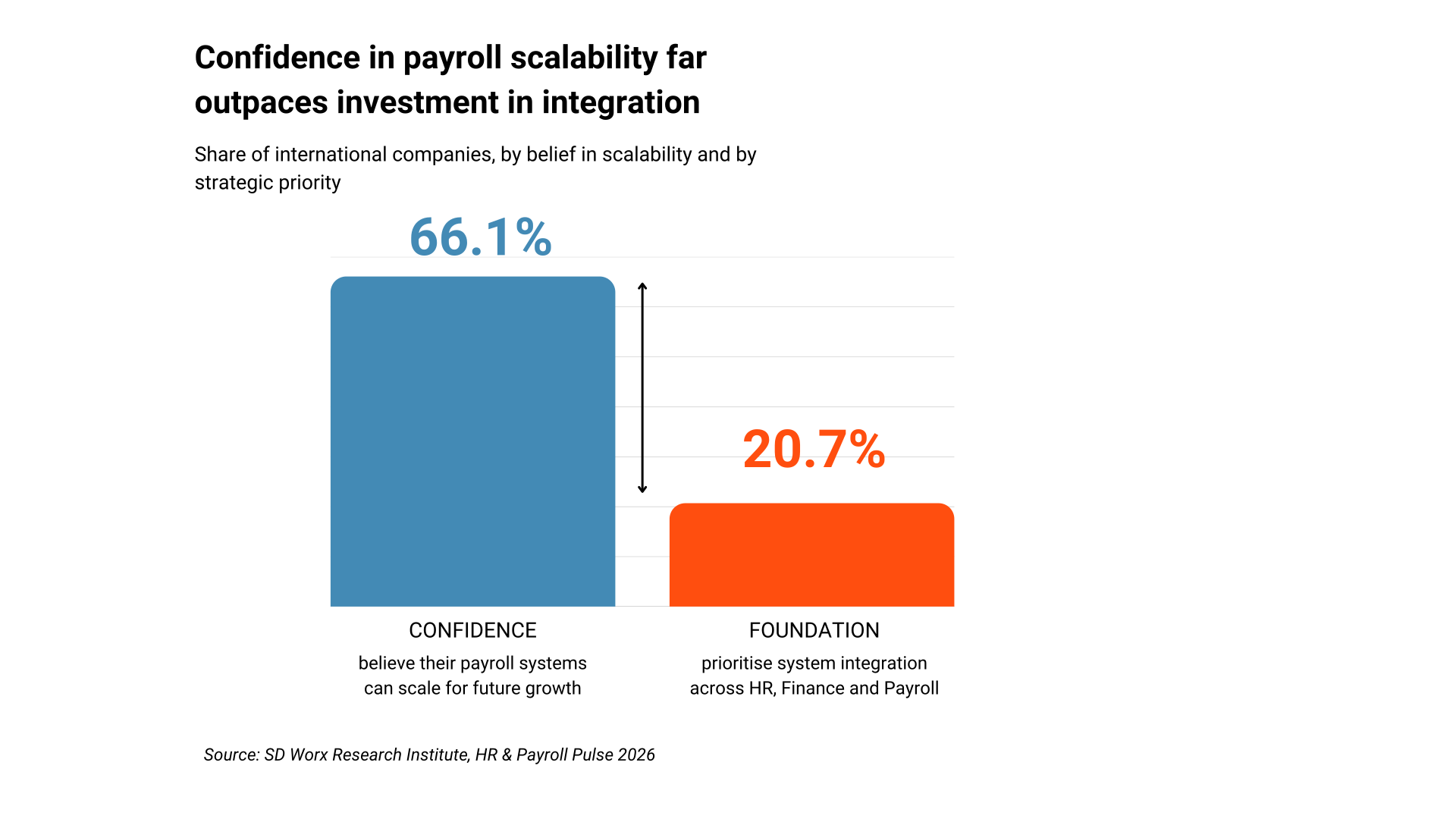
                                          What research learns: Recent numbers of the SD Worx Research Institute show that only 20.7% of international companies currently prioritise system integration across HR, Finance and Payroll in their strategic agenda. Yet 66.1% believe their payroll systems can scale for future growth. That gap between confidence in scalability and underinvestment in the foundations required to achieve it is one of the most telling paradoxes in Global Payroll today. 

                                            This was not a new frustration. Every person in the room had lived it. But it is no longer just a technical inconvenience. It is a structural barrier. Because everything that organisations want to achieve as automation, analytics, compliance visibility or AI; depends on one thing: reliable data flow.  

                                            The discussion drew a useful distinction:  

                                            • Connecting systems. Point-to-point , fragile, hard to scale  
                                            • Orchestrating data flows. Structured, controlled, strategic 

                                            The difference matters. Organisations that treat integration as a series of technical fixes accumulate complexity. Those that treat it as architecture -building a coherent data layer that sits above individual systems, manages how data move across the entire HR and payroll ecosystem, and validates before processing - create the foundation for everything else to work. 

                                              Takeaway: Integration is not infrastructure. It’s strategy.  

                                                Closing — What this means for the industry

                                                The conversation that global payroll needed to have. 

                                                Five themes. Two hours. One room of senior leaders with no reason to filter their views.  

                                                What emerged was not a set of neat conclusions. It was something more useful: a shared understanding of where global payroll actually struggles and where it’s quietly evolving. 

                                                The tensions are not going away. Global will keep pushing for control. Local will keep pushing back with legitimate reasons. Ownership will stay blurred. AI will continue to be overpromised. Data will keep breaking between systems. 

                                                But something is shifting. 

                                                The conversation has moved on. 

                                                Leaders are no longer asking whether to transform payroll. 
                                                They’re asking how, with a clearer view of the trade-offs, the operational realities, and the structural decisions involved. 

                                                That is a different conversation than the one this industry was having five years ago. 

                                                •  The function is maturing.  
                                                •  The questions are sharper.  
                                                • The bar for real answers is higher. 

                                                The roundtable in Barcelona was one conversation. But the themes it surfaced belong to every organisation running payroll across borders. If they resonate, we would like to hear how they play out in yours.