
1. Home>
  2. Insights>
  3. Compliance & Regulation>
Pay Transparency

Pay transparency across borders: when one directive means multiple different conversations

The EU Pay Transparency Directive was written as a single piece of legislation but for organisations operating across borders, it is anything but a single conversation. 

According to the SD Worx HR & Payroll Pulse 2026, 64.4% of internationally operating organisations say they have everything in place to comply with the EU Pay Transparency Directive — ahead of the European average of 62%. Confidence is high, and investment matches it: 59.1% say they are actively investing in greater pay transparency, well above the 54.4% European average. 

But confidence at the top does not automatically translate into understanding on the ground. Only 38.8% of employees in internationally operating organisations say they are aware of the directive and what it means for their rights — a gap of nearly 26% between what employers believe they have built and what employees actually understand. 

That gap is wide everywhere in Europe and especially complex in international companies.   

    The directive behind the data

    The EU Pay Transparency Directive (EU) 2023/970) entered into force in May 2023, but giving member states margin to transpose it into national law by 7th June 2026 — a deadline that has now passed. 

    Once in force locally, employers must build pay structures that guarantee equal pay for equal work or work of equal value, supported by objective, gender-neutral job evaluation methods. Job applicants must be told the starting salary or pay range before interview, and employers can no longer ask candidates about their previous pay.  

    Also, employees gain the right to request individual and average pay information, broken down by sex, for comparable work. Gender pay gap reporting follows a staggered timeline: organisations with 150 or more employees must submit their first report by June 2027, covering 2026 data. SMEs of 100-150 workers have until 2031. Where an unjustified gap exceeds 5%, employers must run a joint pay assessment with employee representatives and act on the findings. 

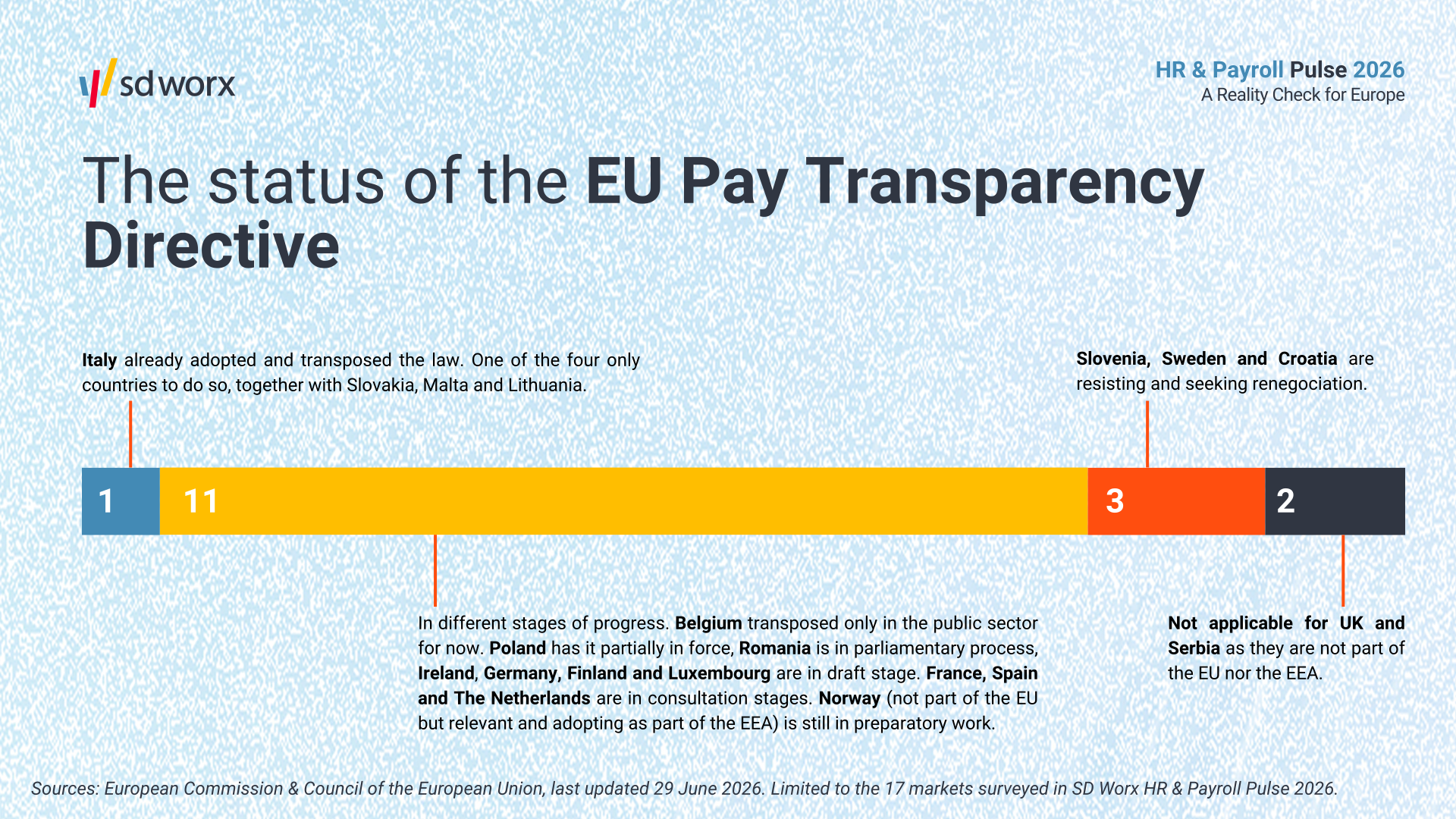
    What the implementation tracker shows, however, is precisely the fragmentation this article describes. As of June 2026, Italy, Slovakia, Lithuania and Malta had transposed the Directive on schedule (countries not in the Pulse report). The Netherlands, Sweden, Czech Republic and Denmark confirmed delays to January 2027 — a request the European Commission explicitly rejected in December 2025, reaffirming that all member states are expected to comply by the original deadline regardless. France and most of the rest missed the deadline, with consultations or drafts still ongoing. 

    And national implementations diverge sharply in substance, not just timing: Italy anchors "equal work" to its national collective bargaining classifications, Cyprus requires employers to jointly agree job-evaluation weightings with employee representatives, and Romania has shortened the response window for pay information requests from the Directive's two months to just 30 working days. 

    For organisations operating in only one of these markets, this is simply "the law", even if new. But what if you operate in more than one of these countries? The headache is real: different compliance calendars, different evidentiary standards, different exemptions, different definitions of what "ready" actually means. All under the banner of a single EU directive. 

      pay transparency europe status
      Sources: European Commission & Council of the European Union, last updated 29 June 2026. Limited to the 17 markets surveyed in SD Worx HR & Payroll Pulse 2026.

      Sources: European Commission & Council of the European Union, last updated 29 June 2026. Limited to the 17 markets surveyed in SD Worx HR & Payroll Pulse 2026. 

        One directive, many realities

        Pay transparency sounds like a single requirement: disclose more, explain decisions, close gaps.  

        In the reality, job architecture differs by market. Salary benchmarking data differs. Local work councils, trade unions and employee representation structures vary significantly and so does the legal definition of what counts as "comparable work" for pay equity purposes. An organisation rolling out a single transparency framework across 10 or 15 countries is not implementing one policy. It is managing 10 or 15 parallel implementations, each with its own legal nuances, while trying to maintain one coherent, fair employee experience regardless of where their people arelocated. 

        This is where the Pulse data becomes especially relevant. Internationally operating organisations report higher readiness across the board — not just compliance (64.4%), but also investment (59.1%) — suggesting global organisations are taking the directive more seriously than average. The risk is not a lack of effort.  

          What employees actually believe

          The employee-side data reveals where the real complexity lives. 

          27.7% of employees in international organisations rate pay transparency as "very important" when deciding whether to join or stay with an organisation — slightly above the 25.3% European average.

          Yet awareness lags far behind that interest. And the gender pay gap data tells an even more pointed story. 44.8% of employers in internationally operating organisations acknowledge having a gender pay gap — notably higher than the 38.9% European average. This is not necessarily a sign that international organisations have worse gaps. It may reflect more rigorous measurement: organisations operating across multiple regulatory environments are often forced to confront and quantify gaps that domestic-only organisations have less pressure to formally assess. 

          What is striking is the employee side of that same question. 31.4% of employees in international organisations believe there is a gender pay gap in their organisation — compared to 27.3% on average. And 42.1% believe their employer is committed to closing it, versus 38.7% Europe-wide. 

          Put together, this paints a picture of international organisations as further along the awareness curve in both directions: employers more willing to name the gap, employees more willing to perceive it. That is progress. But it also means the conversation is happening more visibly, with more scrutiny, and across more audiences simultaneously. 
            Why the message gets lost in translation

            A pay transparency initiative is, fundamentally, a communication exercise before it is a compliance exercise. And communication is exactly where cross-border complexity does the most damage. 

            Consider what a single message has to survive as it moves from a global reward team to a local manager's conversation with an employee. It must hold up under different national legal frameworks. It must be translated, not just linguistically but culturally — what counts as transparent and appropriate to discuss in one market may feel intrusive or even taboo in another. And it must reach a manager who has likely never been trained to explain pay structures with confidence, let alone in a second language or under a legal regime they did not design. 

            Quote from the Pulse research captures this dynamic precisely: "Many people still think they will be able to see colleagues' salaries or their manager's salary. That is not the case. The absence of clear explanation creates false expectations." In a single-market organisation, that misunderstanding is hard enough to correct. Multiply it across markets with different norms around pay disclosure, and the risk of inconsistent — or contradictory — messaging grows substantially. 

              From compliance exercise to trust infrastructure

              The organisations getting this right are not treating pay transparency as a one-time legal deliverable. They are treating it as ongoing infrastructure that has to work simultaneously at two levels: globally consistent in principle, locally credible in delivery. 

              That means in practice building a single, defensible job architecture and pay structure logic that can flex to local market data without losing internal consistency — so an employee in one country and a comparable employee in another are evaluated against the same underlying logic, even if local pay ranges might differ. It means equipping local managers, not just global reward teams, with the specific language and confidence to explain pay decisions in their own market context. And it means recognising that 16 countries will not reach compliance readiness, employee awareness, or cultural acceptance on the same timeline — and building a rollout plan that accounts for that, rather than assuming a single cut launch date will work everywhere. 

                pay transparency global companies

                  The path forward

                  For HR leaders managing pay transparency across multiple markets, the Pulse data points to three practical priorities. 

                  • Separate global principles from local execution. Define what must be consistent everywhere: the fairness logic, governance, the non-negotiables; and clearly identify what must flex by market. Treating every requirement as universal creates friction; treating everything as local creates inconsistency. 
                  • Invest in manager enablement market by market. A global communications toolkit is not enough. Managers need market-specific training that accounts for local legal boundaries and cultural norms around pay conversations, delivered in language and context that lands. 
                  • Track perception gaps by country, not just globally. A 26-point average gap between employer confidence and employee awareness can hide much wider gaps in some markets and much narrower ones in others, don’t just take the average here. Country-level data tells you where to act first. 

                  Pay transparency was designed as a single EU directive. The global organisations that succeed will be the ones that stop trying to standardise the conversation, and start standardising the principles behind it. 

                  Data sourced from the SD Worx HR & Payroll Pulse 2026, conducted by the SD Worx Research Institute in January and February 2026 across 16 European countries, surveying 5,936 HR decision-makers and 16,500 employees. For international organizations specifically, the survey took a sample 2621 HR leaders and 5372 employees.  

                    Full Pulse 2026 report

                    Consult here