
1. Home>
  2. Insights>
  3. Compliance & Regulation>
HR that supports enterprise teams

Global payroll but local risk: Why international organisations can't afford compliance blind spots

Every month, payday comes. And every month, in organisations operating across multiple countries, the margin for error multiplies by each of those locations. 

A missed legislative update in one market or a data protection gap in another. Even errors that go unnoticed for long times (until is too late and they only surface in an audit) due to lack of visibility. None of these cases are rare or exceptional, even when they should.  

 
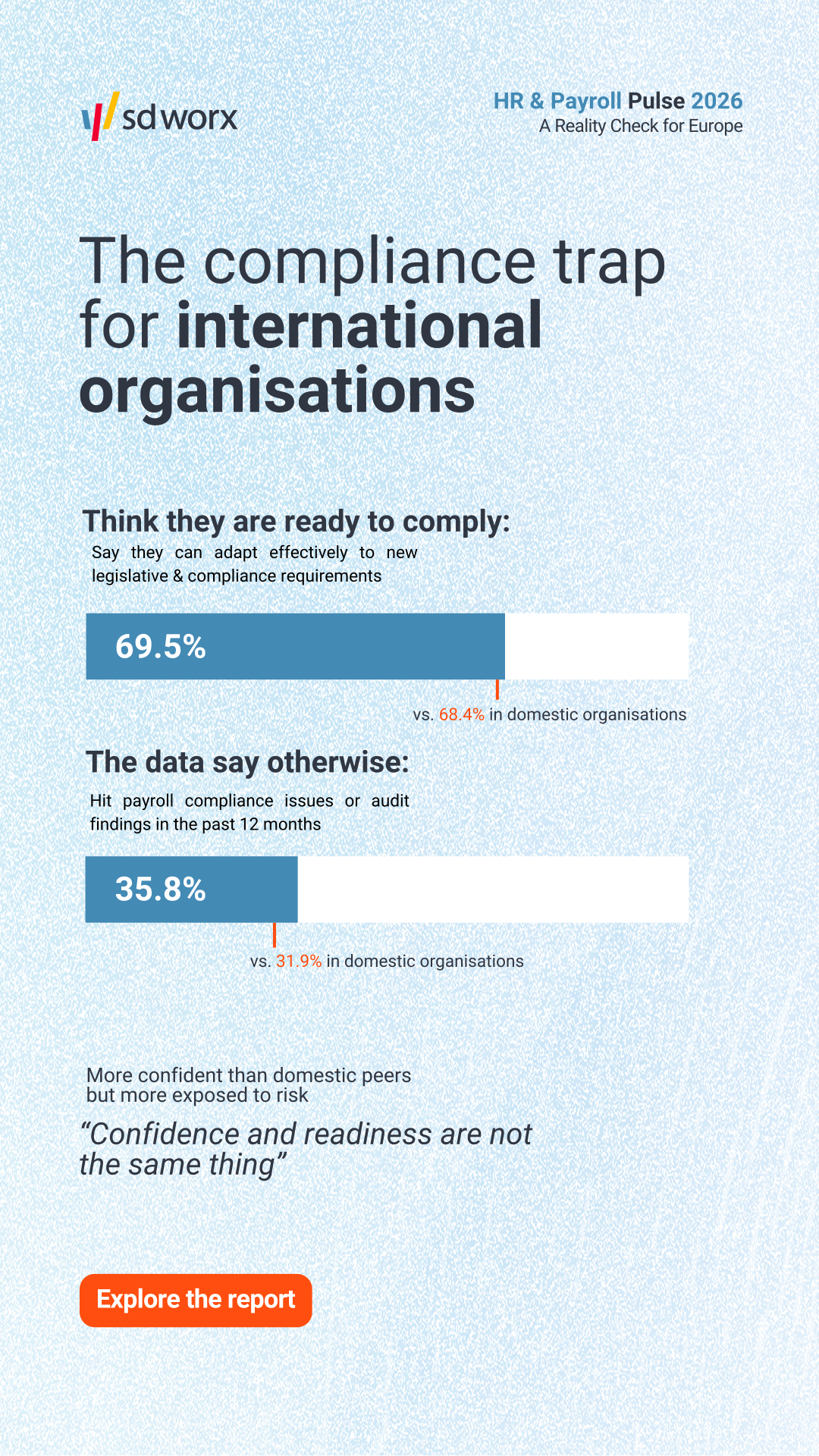
According to the SD Worx HR & Payroll Pulse 2026, 35.8% of internationally operating organisations experienced payroll-related compliance issues or audit findings in the past 12 months — notably higher than the domestic single-market average of 31.9%. 

That gap is not a coincidence but the cost of complexity and scalation. 

    Pulse 2026 report infography
    Source: Pulse 2026 report

      More countries, more exposure

      Organisations operating across multiple markets face a structurally different compliance environment than domestic players. Labour law and tax regulations change at different paces in each jurisdiction. Data protection requirements mightvary in interpretation even within the EU and its common GDPR framework, some small caveats that only experts know how to navigate. And all of it lands on the same payroll function, often without proportionally more resources. 

      The Pulse data tells a clear story here. Internationally operating organisations are more alert to data protection than average: 76.6% say protecting employee data is a top priority (vs. 75.2% average of single markets), and 65.5% feel their systems are sufficiently protected against cyber threats (vs. 62.7%). The good takeaway of that: awareness of this issue is high in the sector, even if insufficient for the moment to prevent them.  

      What the data also reveals is a confidence gap in the ability to adapt. While 69.5% of international organisations say they can adapt effectively to new legislative and compliance requirements, the same organisations are still generating more compliance incidents. Confidence and readiness are not the same thing. 

        The fragmentation problem

        One of the most telling shifts in the Pulse data concerns how organisations are choosing to manage payroll delivery. Among globally operating organisations, 46.8% currently use Managed Payroll Services, already above the European average of 43.9%. More significantly, that figure is expected to climb to 50.3% within three years, while the share managing payroll entirely in-house is projected to fall. 

        This trend reflects a hard lesson many multi-country HR teams have already learned: when payroll systems are fragmented across geographies, the risk compounds. 

        Each country-level system creates its own data flows, its own update cycles, its own potential failure points. When those systems do not connect or are not unified/integrated, reconciliation becomes manual, errors become invisible until they surface in an audit, and trust erodes on both sides: with employees who notice inconsistencies, and with regulators who find them. 

        The move toward managed services is not simply outsourcing. It is a recognition that the outcome requires infrastructure that most internal teams cannot sustain alone across borders. Having a partner that takes care of compliance with clarity and guaranteeing continuity becomes essential.  

          What employees actually experience

          Compliance is often discussed as an employer-sided concern. But its impact lands directly on employees, affecting their trust and causing unease and potential talent retention issues.. 

          The Pulse report asked employees in international operating organisations about their payroll experience. In this case, answers are really close to local companies’ ones. 67.2% said their organisation handles payroll accurately and reliably -identical to the European average. Also, 68.8% said their payslip is easy to read and understand, marginally above the 68.6% local average. 

          These numbers look reassuring. But they sit alongside a compliance incident rate that is meaningfully higher than average. The implication is significant: employees may not know something has gone wrong until it directly affects them. And when it does, the damage to trust is immediate and lasting. 

          Payday is the one touchpoint every employee has with their organisation every single month. It is not a back-office process. It is the clearest, most tangible signal of whether the organisation keeps its promises. For international mobile workforces that reunite employees who may already feel less embedded in a single organisational culture, a payroll failure carries particular weight. 

            Compliance as competitive advantage

            There is a temptation to treat compliance as a floor: the minimum required to operate. The Pulse data suggests that leading organisations are beginning to treat it differently and more as a signal of operational maturity. 

            In the multi-country context, compliance readiness means several things in practice. It means having systems that update automatically when legislation changes in a given market, rather than relying on a team to track and manually implement every regulatory shift across 10 or 15 jurisdictions. It means having audit-ready evidence built into the process, not assembled retrospectively. And it means treating data protection not as a checkbox but as a capability. 

            Organisations that get this right do not just avoid fines but build the kind of structural reliability that makes workforce planning more accurate, employee trust more durable, and HR's role in strategy more defensible. 

              The path forward

              For HR leaders in internationally or European operating organisations, the Pulse data points to three practical shifts worth prioritising: 

              • Treat payroll compliance as a cross-border risk function, not a country-by-country administrative task. Compliance incidents are more common in multi-market organisations precisely because risk is managed locally while exposure is global. A real-time and centralised view of compliance status is the starting point. 
              • Close the gap between confidence and readiness. The fact that internationally operating organisations feel more confident about compliance than average, while experiencing more incidents is a warning sign. Confidence built on assumption is fragile. Resilience requires regular stress-testing: legislative impact reviews, breach response simulations, access control audits. 
              • Choose payroll partners based on governance, not just geography.  As more organisations shift to managed payroll services, the criteria for choosing a provider become critical. It’s not just about country coverage, it’s about the ability to adapt to regulatory change, ensure clear accountability, and consistently deliver reliable, high-quality service. 

                Payroll is not a solved problem for multi-country organisations. The complexity is structural, and it grows with every new market added. But organisations that recognise this are building one of the most durable foundations of workforce trust. They understand this as a priority both for the management of the business and for their employees and they care enough to get the needed help. available to them./ 

                The monthly payday, in many ways, is the ultimate test of whether an organisation delivers on what it promises. Across borders, that test gets harder. The organisations that pass it consistently are the ones that have stopped treating payroll as a local operational function and started treating it as what it actually is: a pan-European responsibility that sits at the heart of how work runs. 

                Data sourced from the SD Worx HR & Payroll Pulse 2026, conducted by the SD Worx Research Institute in January and February 2026 across 16 European countries, surveying 5,936 HR decision-makers and 16,500 employees. For international organizations specifically, the survey took a sample 2621 HR leaders and 5372 employees.